
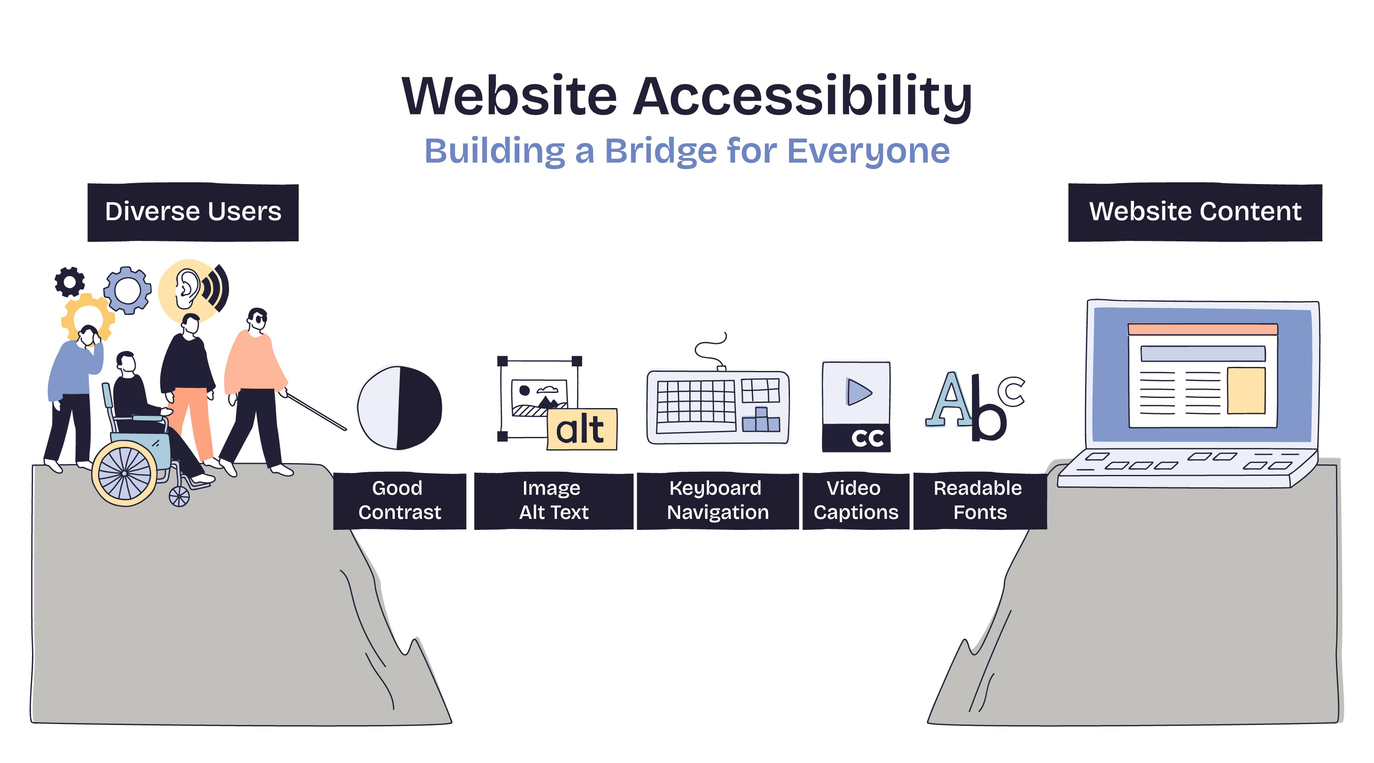
Over the past year, many business owners have started hearing more about ADA website accessibility, often in the context of lawsuits, legal notices, or alarming headlines. While the subject can feel overwhelming, understanding the basics can help you make informed, practical decisions without panic or pressure.
Why Website Accessibility Is Getting More Attention
The Americans with Disabilities Act (ADA) was enacted to ensure equal access to goods and services for individuals with disabilities. While the law predates the modern web, courts have increasingly interpreted it to apply to business websites, particularly those that serve the general public.
As awareness of accessibility standards grows, so does scrutiny. In recent months, there has been an uptick in lawsuits related to website accessibility, many involving businesses that were unaware their websites had potential compliance issues. In many cases, these actions occur without warning, leaving business owners surprised and frustrated.
What “Website Accessibility” Really Means
Website accessibility focuses on making sure people with disabilities can use and navigate your site effectively. This may include visitors who:
- Use screen readers due to visual impairments
- Rely on keyboard navigation instead of a mouse
- Have color-blindness or low vision
- Experience cognitive or motor challenges
Accessibility guidelines are commonly based on the Web Content Accessibility Guidelines (WCAG) developed by the World Wide Web Consortium (W3C), the primary international, non-profit organization that develops open, royalty-free standards to ensure the long-term growth, accessibility, and interoperability of the web. The WCAG standards outline best practices such as readable text, proper contrast, keyboard navigation, and descriptive labels for images and forms.
Not All Websites Carry the Same Risk
It’s important to note that ADA risk is not one-size-fits-all. Factors such as business type, audience, website complexity, and public interaction all play a role. Accessibility is also not a “pass/fail” condition, it’s an ongoing process of improvement rather than a single checkbox.
That’s why understanding your current situation is more useful than reacting to headlines.
Why Accessibility Is About More Than Legal Risk
Beyond compliance concerns, improving accessibility often leads to:
- Better usability for all visitors
- Improved SEO and search visibility
- Stronger user trust and brand credibility
- Broader audience reach
In other words, accessibility improvements often benefit every user, not just those with disabilities.
Taking a Practical, Measured Approach
At Web Propulsion Hosting, our goal is to help clients stay informed, not alarmed. A good first step for any business owner is simply understanding how their website performs today.
That’s why we offer a free website accessibility scan that provides a snapshot of potential accessibility concerns based on common standards. This scan is informational and can help guide thoughtful next steps, if any are appropriate.
For businesses that wish to go further, there are tools and solutions available that assist with ongoing accessibility improvements. However, every business is different, and there is no single “right” path for everyone.
Final Thoughts
ADA website accessibility doesn’t have to be confusing or intimidating. Awareness, education, and small, reasonable improvements go a long way. Whether you’re just learning about accessibility or already exploring enhancements, the most important step is staying informed and proactive.
If you have questions about your website, want to review an accessibility scan, or simply want to talk through what makes sense for your business, Web Propulsion Hosting is always here to help, no pressure, no scare tactics, just clear guidance.
Give us a call to schedule a no-cost, no-obligation accessibility review of your website. We’re here to help. Call (904) 351-8264.